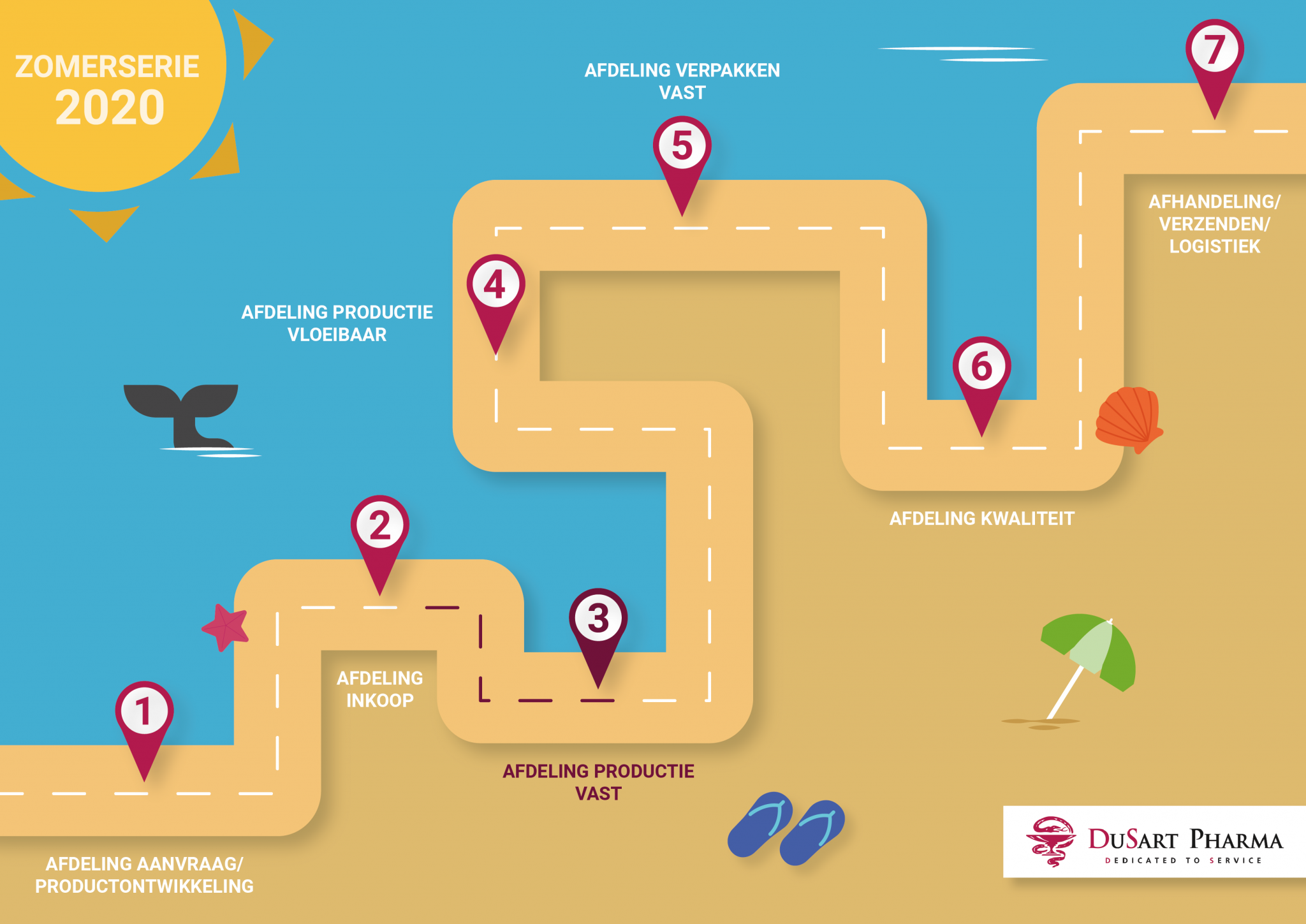
In our summer series, we have so far heard from the Enquiries & Product Development and Procurement departments. Now that it is clear what the customer wants and the raw materials have been procured, it is time to start production. Today we are discussing the production of our solid products. Next week we will look at the production of our liquid products.
This week, we visited the Solid Production department and spoke to our senior technical operators, Willem Groen and Ronald van der Velden.
Gentlemen, could you tell us a bit about the Solid Dosage Form department?
We are responsible for the production of DuSart’s solid dosage forms, mainly tablets and capsules. The Solid Dosage Form department consists of mixers who blend the powders so that they can be used to fill the capsules or compress the tablets, and operators who, broadly speaking, set up the machines, refill them, carry out checks and resolve minor faults. In addition, our department has technical operators who carry out the same tasks as the operators but have a deeper understanding of formulations and the machinery. They are also responsible for transferring knowledge to the operators. They know the machinery inside out and work closely with the technical department.
Last but certainly not least are the industrial cleaners, who continuously ensure that the premises and machinery are cleaned in accordance with strict quality standards.
We have a large fleet of machinery at our disposal. Each operator is responsible for their own machine – even when it is being operated by another operator – and knows it inside out. To meet rising demand, we have decided to expand our machinery fleet with yet another tableting machine! More on this later in our monthly newsletter.
We are producing a summer series covering the entire process at DuSart Pharma: from enquiry to dispatch. When do you come into the picture?
Based on the customer’s enquiry, we are provided with a protocol containing the formulation. The mixer has already blended the ingredients in advance and delivers them in drums to the operator. The operator sets up the machine and ensures that the (as yet empty) capsules (in the case of capsule production; this is not the case for tablets) are also fed into the machine. Production can then begin for a known product. For a new product, a test phase takes place first to ensure that the product has been formulated correctly.
How many solid products does Dusart produce each year?
We produce many millions of capsules and tablets per year, and this figure is growing significantly.
DuSart Pharma is Dedicated to Service. How is that reflected in your department?
Our ‘Dedicated to Service’ ethos is embodied in our knowledge and expertise, and in our collaboration with the customer. We manufacture a wide range of products, to which new items are added every year. It is then our task, in collaboration with the Product Development, Quality and Sales departments, to create the correct formulations. Samples are then produced and tested on the machinery. The aim is to arrive at a formulation that processes well on our machinery. This is a bespoke process every time. We constantly take the client’s requirements into account and liaise with them throughout the process. We are delighted to offer this service, and it is what sets us apart as DuSart. For us, this is the main reason for choosing to work here rather than at another company.
Our team is well-represented, with a mix of young and older staff. It’s also a close-knit and warm team. Gerdolf, for example (who joins us during the interview), started here as a trainee operator in 2016 and has since become an indispensable part of the Solid Products department. Gerdolf: “It’s precisely that family-like atmosphere at Dusart that makes me enjoy working here. I wouldn’t want to be just a number somewhere else. I get a real sense of fulfilment when a formulation process is proving difficult but ultimately results in a great product thanks to our problem-solving, one that all parties can be proud of. These challenges arise precisely because we manufacture and develop so many different products.”