In one of our previous newsletters, we explained what herbal simplex and complex formulations are. This time, we’re looking at our Quality Control Lab, and in particular DLC, or thin-layer chromatography. What exactly is it, and when do we use it?
Check, check, double-check
The most important part of the production process for food supplements is the careful selection of raw materials. These raw materials form the basis of the end product, and their quality is essential for the product’s ultimate effectiveness and safety. We have a Quality Control laboratory for this purpose. This department has a highly responsible role: only once it gives the go-ahead can the production process begin and the final product be dispatched to the customer. Among other things, we carry out incoming inspections on packaging materials and raw materials. As part of this inspection, we carry out a number of different analyses, such as FT-IR (Fourier Transform Infrared Spectroscopy) and TLC (Thin-Layer Chromatography).
Thin-layer chromatography
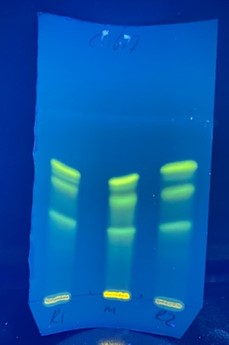
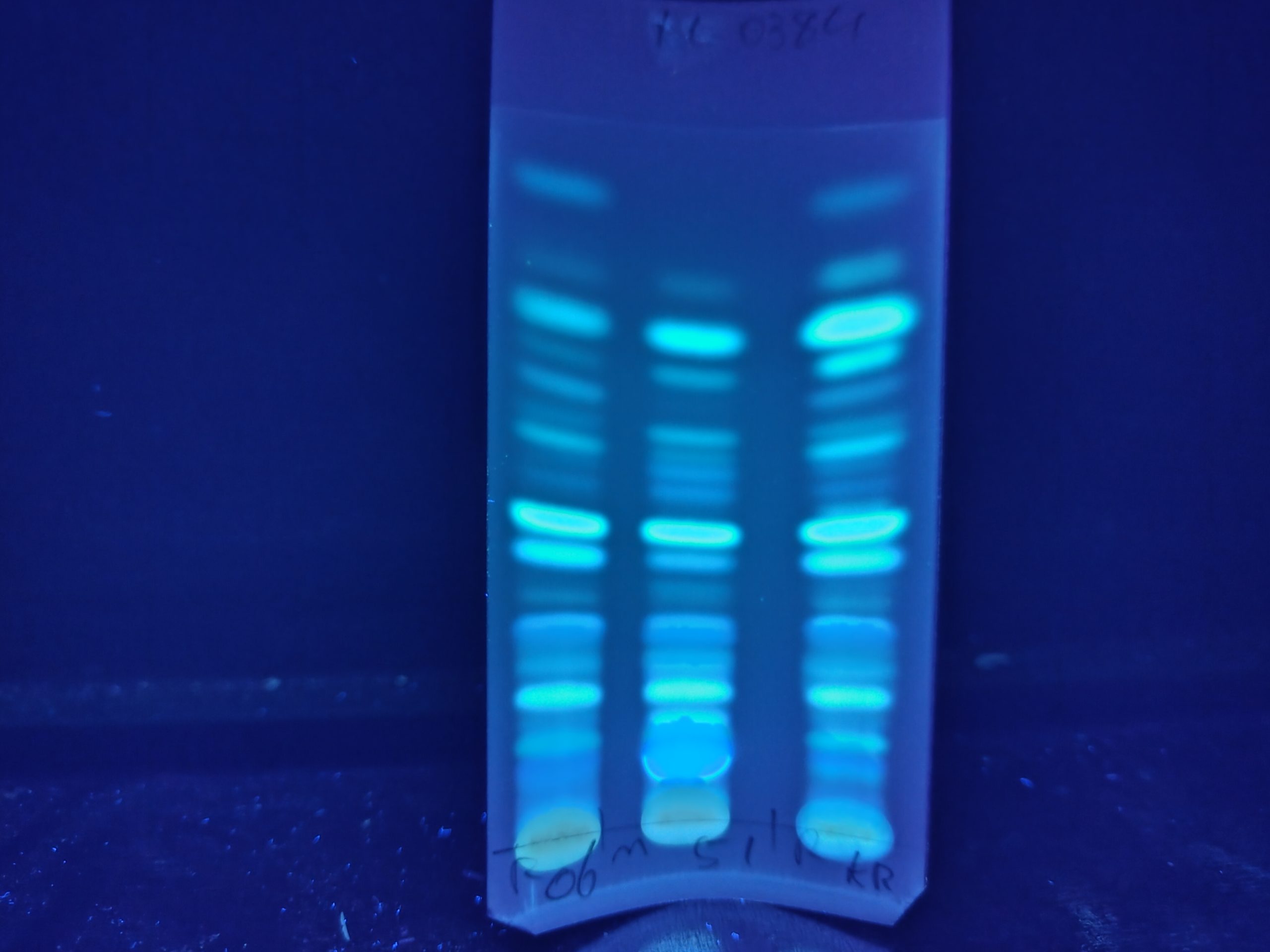
We’ll look specifically at thin-layer chromatography. We apply this to the herbs and extracts we source so that we know exactly which substances they are composed of. You can think of it as a sophisticated version of a colouring-in picture, where we aim to distinguish the different colours within a sample. TLC is often carried out automatically, but we choose to perform this check manually.
We first boil the herb or extract and then apply it to a silica gel plate. We then place this silica gel plate in a mobile phase, also known as an eluent. The various components in the mixture move through the plate at different speeds as the solvent rises; this gradually creates a specific band pattern that is unique to this herb or extract. This is particularly clearly visible under a UV lamp. This allows us to see exactly what it is composed of. Alongside the sample that has just arrived, we run two reference samples (material received earlier) for comparison. If the patterns match, the sample is approved and given the green light for further use!